

A New Dashboard for Health and Accident Insurance
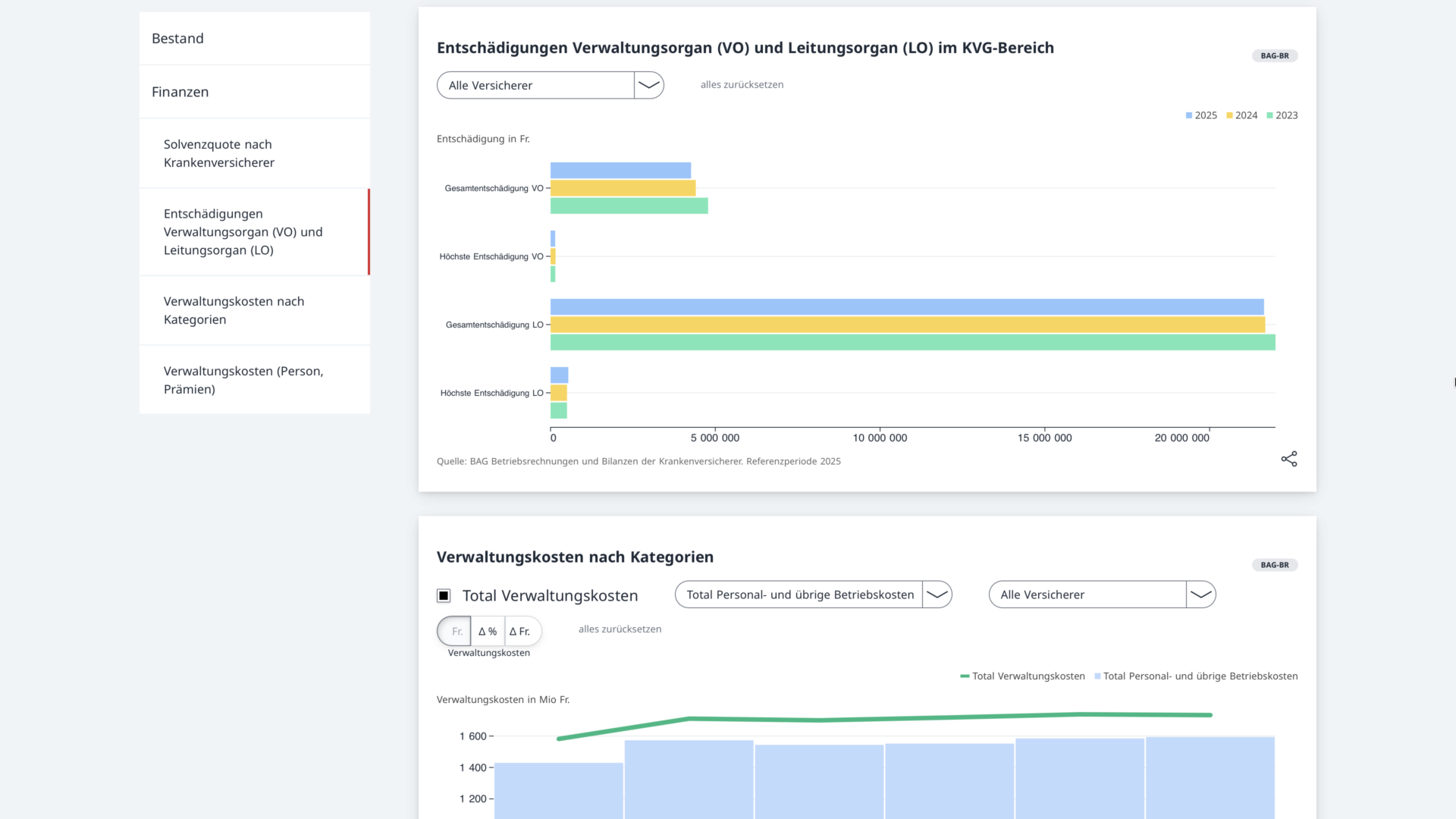
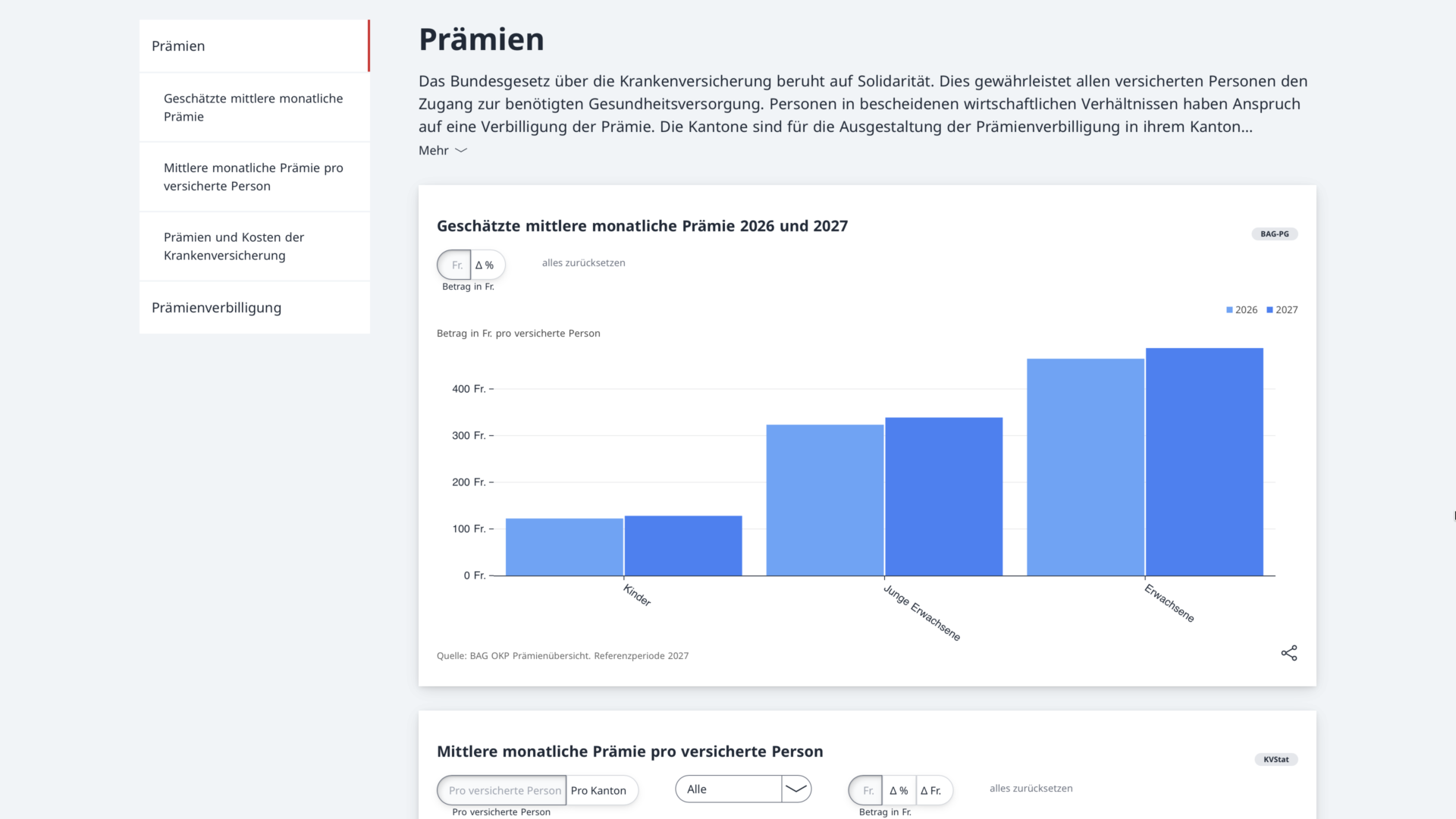
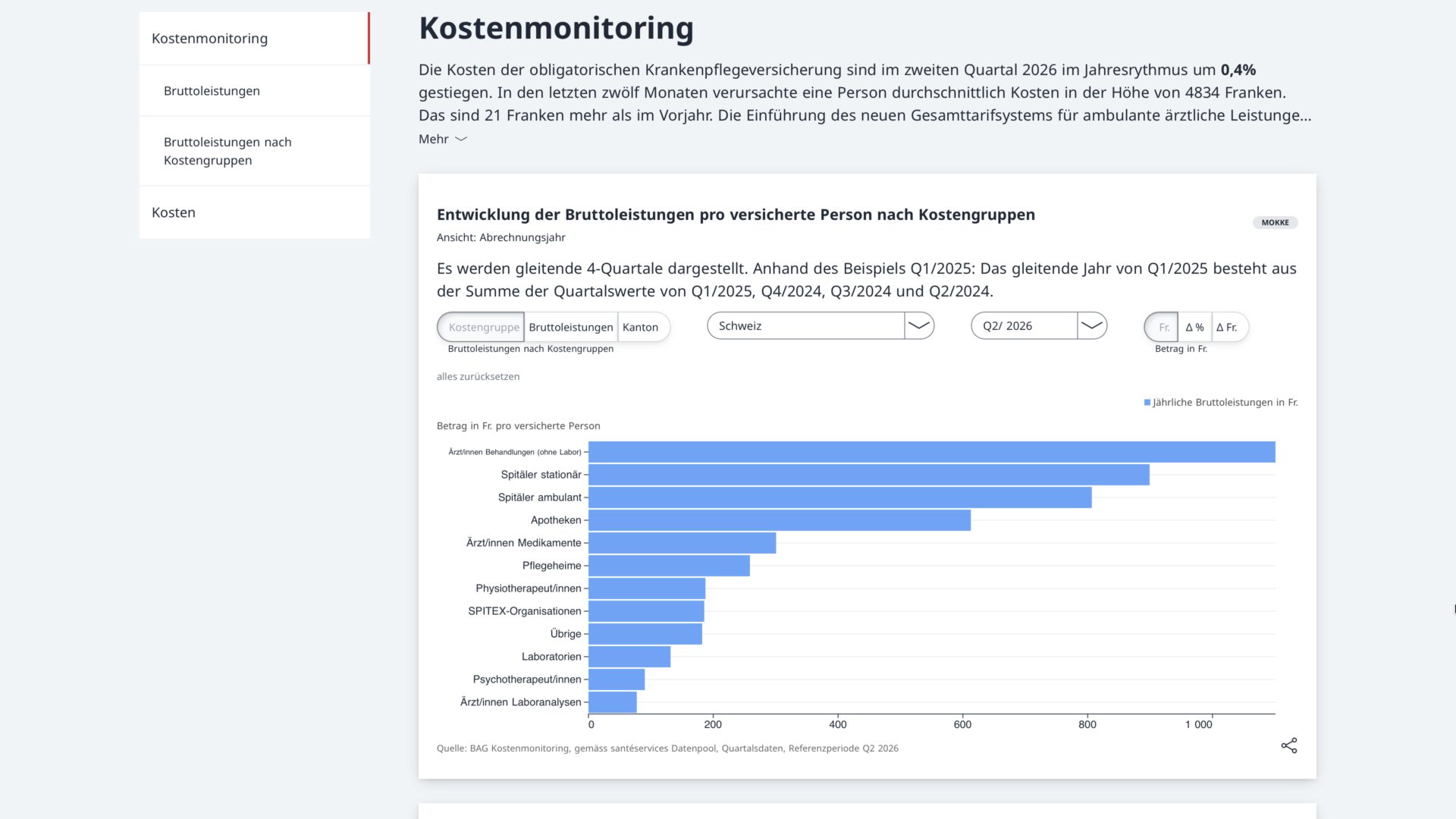
We designed and developed a new health insurance dashboard (https://kvd.bag.admin.ch/de/home) for the Federal Office of Public Health (BAG): a cloud-based web application that visualizes data in interactive charts.
The platform makes key metrics on costs and cost monitoring, premiums, insured individuals, and health insurers accessible and interactive for various target groups – politicians, government agencies, specialized organizations, journalists, and the general public.
THE CHALLENGES
The Federal Office of Public Health (BAG) is responsible for mandatory health insurance, accident insurance, and military insurance. Our client is the Health and Accident Insurance Division (KUV) of the BAG.
Based on a pilot study conducted in 2024, we had already demonstrated how the KUV Dashboard could be implemented as a standalone application on the existing infrastructure using the Infectious Diseases Dashboard (IDD) platform. As a result, we were commissioned to replace the existing health insurance dashboard (an in-house development by the BAG based on Apache Superset) with a sustainable, modular, and interactive solution.
At the start of the project, a new cross-departmental target architecture was introduced: the BAG Platform (Azure Hub and Spoke Platform). The target architecture is not compatible with the IDD infrastructure and was only in its early stages at the project’s outset. The BAG Platform is being developed within the framework of a SAFe organization, incorporating numerous BAG IT projects and evolving requirements.
In addition to the new infrastructure requirements, we faced other challenges, including:
- Complex data. Costs and cost monitoring, premiums, insured individuals, and health insurers should be presented clearly using various chart types and KPIs.
- Diverse target audiences. Politicians, government agencies, specialized organizations, journalists, and the general public should be able to use the data interactively—each with their own specific needs regarding depth and presentation.
- Heterogeneous data sources. Data from various sources, databases, and formats had to be converted into a uniform format and made available to the various stakeholders.
OUR APPROACH
Leveraging synergies from the EPI Information Portal
Based on our experience with the Infectious Diseases Dashboard (IDD), we were able to directly incorporate established functionalities – such as the share function, the API, and data exports – as reusable library components. After implementing the basic features, we adopted additional features and adapted them for the KUV Dashboard.
Collaboration directly within the architecture team
As one of the first projects on the new BAG platform, the KUV Dashboard played a pioneering role. Our application architect collaborated with the architecture team for the interagency platform to build the infrastructure. Thanks to this direct collaboration by our application architect, technical interfaces were coordinated early on and challenges were efficiently resolved.
Making data universally usable
To efficiently utilize data from various sources and in different formats, we designed and developed our own transformer: an Azure Functions-based pipeline that extracts raw data from a dedicated storage account, standardizes it by column and value, enriches it with business-specific information (including aggregated series, percentage shares, and change values compared to previous periods), and makes it available as a versioned, publishable artifact.
The transformed data sets are imported into a shared target model via a sync handler and are only made publicly available after an explicit activation step in the middleware. A “version stacking” concept ensures that new data deliveries need to contain only the business content that has actually changed, while unchanged content is automatically carried over from the most recent valid version – this reduces redundancy and maintenance effort without compromising the business continuity of the data series.
Tech Stack Used
The solution runs across four environments (Dev, Ref, Uat, Prd) based on Azure Container Apps and Azure Static Web Apps, with Infrastructure-as-Code managed via Terraform. The interactive diagrams are created using D3.js. The application’s content and text are managed through a CMS (Craft) and can be easily updated by business users at any time.
THE RESULT
In late summer 2026, the new health and accident insurance dashboard went live and successfully replaced the previous health insurance dashboard.
The KUV Dashboard is one of the first customer-facing projects to go live on the new BAG platform. The overarching infrastructure meets the highest standards for security and data protection and is designed for long-term operation.
The data is made available through multiple channels and endpoints: via an API, on opendata.swiss, in interactive visualizations, and through file exports. A modular structure consisting of cards and charts, along with a standardized data format, provides a stable foundation for production.
This platform will enable the FOPH to publish additional data and visualizations in the coming months and years and to provide the various target groups with information tailored to their specific needs.

ABOUT BAG
The Federal Office of Public Health (BAG) is part of the Federal Department of Home Affairs (FDHA) and is committed to promoting public health and ensuring affordable, high-quality health care. In the area of insurance, the BAG is responsible for regulating and supervising mandatory health insurance (KVG), accident insurance (UVG), and military insurance (MVG). The KUV Dashboard makes key metrics from this area accessible to policymakers, government agencies, specialized organizations, the media, and the public.
LEARN MORE